
NEW YORK — Moe Rock’s vision for The New York Globe starts with a premise that runs against much of the modern media business: a newspaper does not have to choose between relevance and optimism.
Rock, the media executive who has overseen the expansion of The Los Angeles Tribune into publishing, film, live events and audio production, is now bringing that philosophy to New York. His goal is to build The New York Globe into a broader media institution—one that still covers business, culture and public affairs, but places greater emphasis on constructive stories, leadership and people attempting to build something of lasting value.
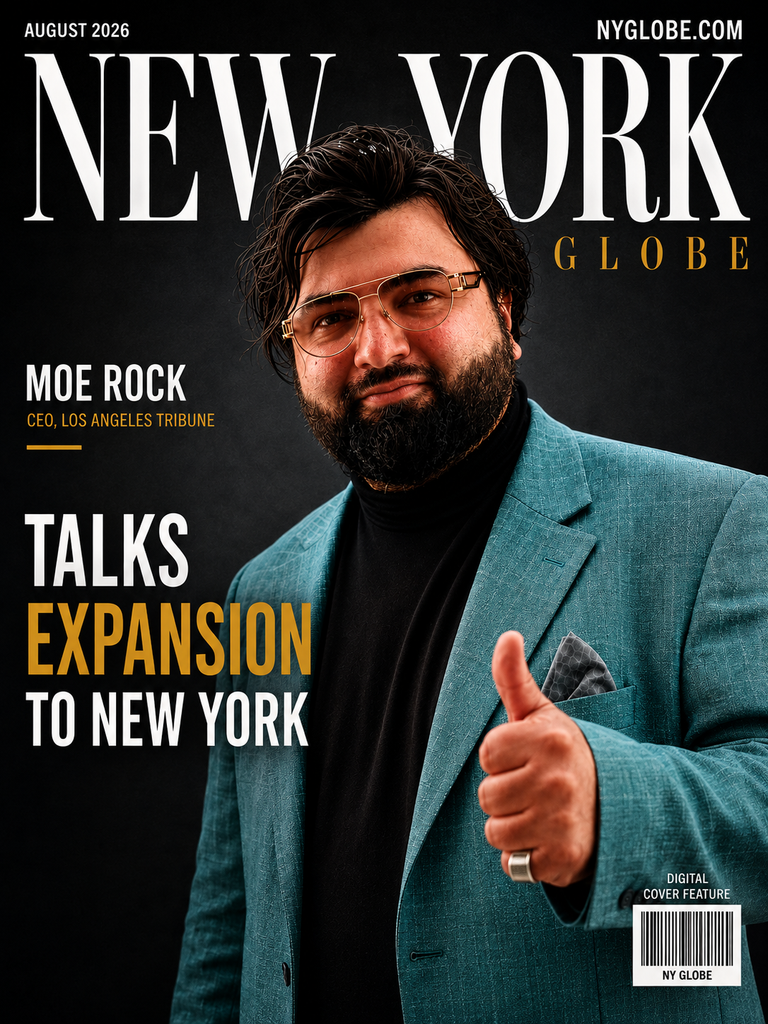
It is an approach shaped by what Rock has already tried in Los Angeles.
Under his leadership, The Los Angeles Tribune has moved beyond the traditional boundaries of a newspaper. The organization operates a publishing house, developed a film division and built the Los Angeles Tribune International Film Festival, which returned this month at the Culver Theater in Culver City with films and filmmakers from around the world. The festival’s own materials identify Rock as its founder. (La Tribune Film Festival)
The Tribune has also expanded into long-form audio. Its publishing arm produced and published You Know It’s True: The Real Story of Milli Vanilli, narrated by Fab Morvan and written by Morvan and Parisa Rose. The project received a Grammy nomination in the audiobook, narration and storytelling category, with the Los Angeles Times noting Morvan’s return to Grammy contention more than three decades after Milli Vanilli’s award was revoked. Los Angeles Tribune Publishing is listed as the project’s publisher and producer. (Los Angeles Times)
For Rock, those ventures are not separate businesses so much as extensions of the same idea: journalism can be a platform for creating culture, not simply documenting it.
That philosophy is expected to shape the next chapter of The New York Globe.
From Newspaper to Media Platform
The traditional newspaper model has been under pressure for years. Advertising has migrated to technology platforms. Social-media companies have weakened publishers’ control over distribution. Audiences have become more fragmented, while many local and regional publications have reduced staff or disappeared entirely.
Rock’s response has been diversification.
Rather than treating a newspaper as a single product, he has sought to turn the Los Angeles Tribune name into a platform spanning journalism, books, audio, film and live experiences.
The strategy is visible in Pillars of Power: The Hidden Secret Behind Achieving Greatness, the feature documentary produced through the Los Angeles Tribune Film Division and directed by Rock and Dawna Campbell.
The documentary brings together figures from business, personal development and leadership, including Joe Vitale, John Demartini, John Assaraf, Sharon Lechter, Ken Honda, Marie Diamond and others. It examines five areas of life—money, relationships, health, mental wellness and spirituality—and argues that achievement is broader than professional status alone. (The Los Angeles Tribune)
The film premiered in California in June and later received a theatrical release. LAT Productions has since announced that the project will expand into a six-film documentary series. (EIN Presswire)
Next month, that strategy arrives in New York in a particularly visible way.
The SVA Theatre in Chelsea lists a New York City premiere of Pillars of Power for Sept. 11 at 6 p.m. The screening gives Rock an opportunity to introduce both the film and the larger media philosophy behind it to a New York audience. (SVA Theatre)
For The New York Globe, the timing is deliberate.
A film produced through a newspaper-affiliated production company appearing in a Manhattan theater illustrates the model Rock wants to pursue: the publication becomes a starting point rather than the end product.
A Bet on Positive News
The more unusual part of Rock’s strategy is editorial.
He argues that the relentless emphasis on conflict, outrage and institutional failure that dominates much of the contemporary news cycle has created an opening for a different kind of publication.
That does not mean avoiding difficult subjects or replacing reporting with public relations. Rock’s stated objective is to place greater weight on stories about achievement, constructive leadership, cultural progress and individuals or institutions attempting to solve problems.
The distinction matters.
There is a long history of so-called positive-news publications drifting into advocacy or promotion. For The New York Globe to establish credibility in a crowded New York media market, it will have to maintain the standards readers expect from serious journalism: verification, independence, skepticism and a willingness to publish facts that are inconvenient to the people being covered.
Rock’s opportunity is to demonstrate that those standards are compatible with a less cynical editorial worldview.
In business terms, the strategy also represents an attempt at differentiation.
New York already has one of the most competitive media markets in the world. The city is home to national newspapers, television networks, financial-news organizations, digital startups, magazines and a dense ecosystem of specialized outlets.
Competing on volume would be difficult.
Competing on identity may be more realistic.
The New York Globe can position itself around a recognizable proposition: serious news and cultural coverage with a deliberate interest in builders, innovators and people creating measurable impact.
If the model works, the publication could occupy territory between traditional metropolitan journalism and the expanding world of leadership, business and cultural media.
Lessons From Los Angeles
The Los Angeles Tribune provides Rock with a working laboratory.
Its expansion has not followed the typical trajectory of a regional newspaper. Instead, the organization has developed adjacent businesses that reinforce one another.
The film festival creates events and relationships with filmmakers. The film division produces original intellectual property. The publishing house creates books and audio projects. Those projects can then generate journalism, events and partnerships of their own.
That ecosystem was particularly visible with You Know It’s True.
The audiobook was published by Los Angeles Tribune Publishing and later received Grammy recognition, while Rock also received producer credit on another Grammy-nominated spoken-word project, Marc Marcel’s Black Shaman. (The Los Angeles Tribune)
Few newspaper companies are structured to participate directly in the production of Grammy-nominated audio or feature documentaries.
That is precisely the point.
Rock is betting that the boundaries separating a newspaper, publishing company, production studio and events organization are becoming less useful.
The strongest media brands of the future, in this view, will not simply publish articles. They will create intellectual property, convene communities and move stories across multiple formats.
The New York Test
New York will be a considerably larger test of that theory.
The city offers enormous opportunity, but it also punishes brands that appear manufactured or overly promotional. Credibility is difficult to establish and easy to lose.
That gives The New York Globe’s expansion a dual challenge.
It must grow without diluting its journalism, and it must pursue positive storytelling without becoming predictable.
Rock appears aware that the value of an optimistic publication depends on readers believing its optimism has been earned.
The long-term opportunity is larger than a single website or a single film screening.
If The New York Globe can combine credible reporting with the wider media infrastructure Rock developed in Los Angeles, the publication could become a platform for journalism, film, books, events and cultural programming centered in one of the world’s most influential cities.
The Sept. 11 screening of Pillars of Power will offer an early public glimpse of that strategy.
For Rock, it represents more than the New York arrival of a documentary.
It is a statement about what he believes a newspaper can become.

