
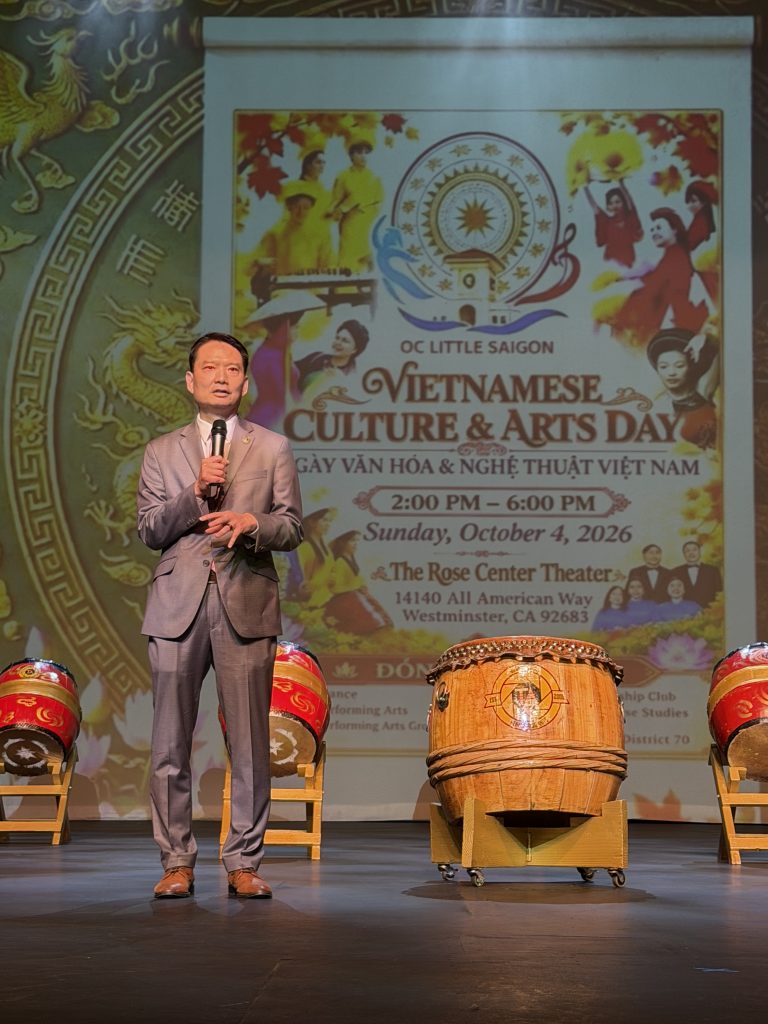
On Sunday, October 4, 2026, the Rose Center Theater in Westminster became a gathering place for generations of Vietnamese Americans and a living showcase of the music, dance, language, history, and traditions that have traveled across oceans and endured across generations.
The OC Little Saigon Vietnamese Culture & Arts Day – Ngày Văn Hóa & Nghệ Thuật Việt Nam, presented in partnership with the Office of California State Assemblymember Tri Ta, District 70, brought together seven nonprofit cultural organizations with a shared purpose: to preserve and advance Vietnamese culture and arts for future generations while sharing the richness and beauty of that heritage with the broader community.
The four-hour program was remarkable not only for what appeared on stage, but also for the history represented by the organizations behind it. Some have served the Vietnamese community for nearly four decades. Others were founded more recently to respond to the same fundamental challenge: how do we make sure the language, music, performing arts, and cultural traditions brought to America by one generation remain meaningful to the generations that follow?
Seven Organizations, Decades of Cultural Preservation
The seven participating organizations tell an important story of Vietnamese cultural life in Southern California.
Lac Hong Performing Arts Group, the performing branch of the nonprofit Vietnamese Traditional Arts Development Organization, traces its history to 1988, when it was founded by former Saigon National Conservatory professors Nguyen Thi Mai and Nguyen Van Chau. For nearly 40 years, Lac Hong has preserved traditional Vietnamese music, folk songs, and dance overseas, passing that heritage across generations of performers. Today, its Youth Group actively teaches and performs at high schools and universities throughout Orange County. Its longevity demonstrates something essential about cultural preservation: traditions survive when one generation makes the deliberate decision to teach the next.
The Ngan Khoi Chorus has similarly devoted more than 36 years to artistic service within the Vietnamese community. Founded through the efforts of Professor Le Van Khoa, conductors Tran Chuc and Tran Anh Linh, and director Tong Nhuan, the group was established in 1989. Its mission is to preserve, develop, and share Vietnamese music—particularly the genre of artistic choral music—with younger overseas generations and international audiences. Through large and small concerts, chorus and orchestra, Ngan Khoi has presented major Vietnamese musical works including Mẹ Việt Nam, Hội Trùng Dương, and Hòn Vọng Phu. The works of many talented Vietnamese composers have been carefully rehearsed and performed by its members under dedicated conductors.
Viet Cam Dance, founded in 1998, has carried Vietnamese dance far beyond Southern California. Its performers have appeared in the Philippines, Japan, Taiwan, Australia, Canada, France, and throughout the United States. Most of its dancers are students who spend their weekdays in school and their weekends learning Vietnamese dance. Its mission is to preserve Vietnamese culture, promote cultural diversity in America, and participate in community events including the Lunar New Year Festival, King Hùng commemoration, Vietnamese New Year Parade, and fundraising activities. Their commitment illustrates how cultural education can become part of the lives of young Vietnamese Americans rather than something separate from them.
Thien An Performing Arts began in 2005 with a simple but important idea: to keep Vietnamese traditional arts alive. What began as a small group of passionate students practicing in borrowed parking lots and garages has developed into an organization of approximately 100 performers spanning all ages and skill levels. Its growth has been powered by the community—from supportive parents and dedicated instructors to generous event partners. Some students have returned as instructors themselves, creating exactly the cycle cultural preservation requires: students become teachers, and recipients of tradition become its guardians.
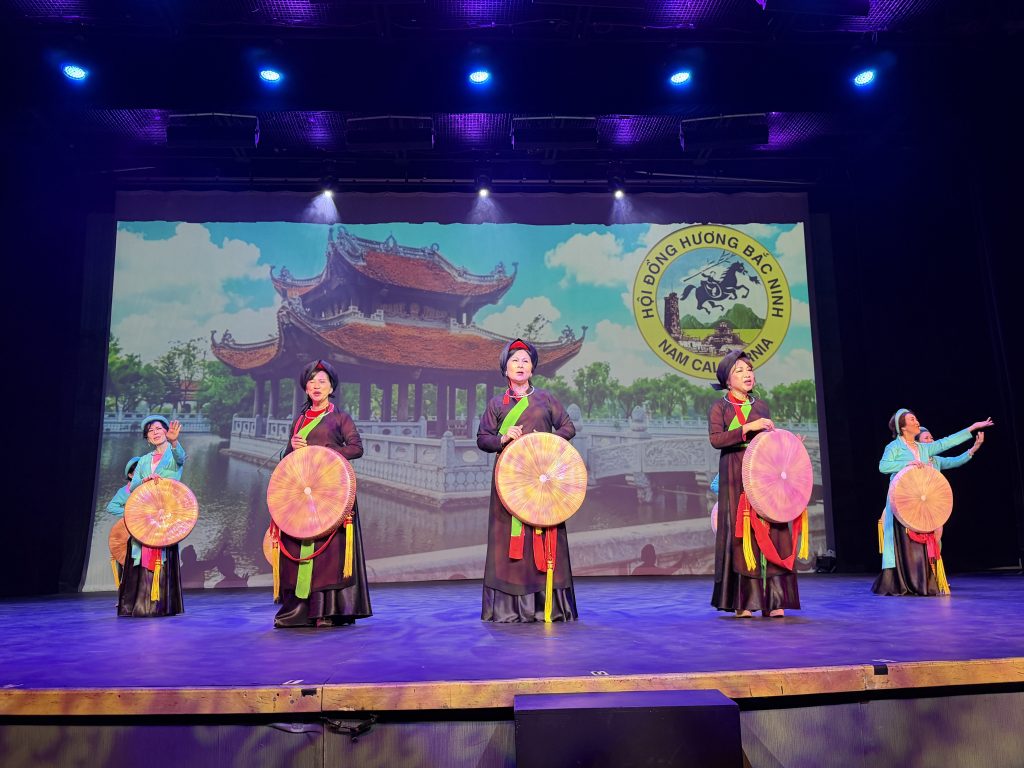
The Vietnamese Artists Friendship Club, founded in 2010 by Composer Anh Bang and Dr. Cao Minh Hung, has a mission to preserve and promote Vietnamese culture in the diaspora. The organization guides younger generations in preserving their heritage through free Vietnamese classes and music and dance programs. That combination is particularly significant because language and the arts reinforce each other. Songs carry words. Music carries stories. Dance carries traditions. Together, they allow culture to be learned not simply intellectually, but emotionally. The Traditional Bac Ninh Culture Association of Southern California, established in 2006, has spent two decades promoting the distinctive cultural and historical traditions of Bắc Ninh. The association organizes annual festivals and cultural events, while its special editions and anthology have become resources for researchers and those interested in Bắc Ninh culture and history. Its work reflects an important dimension of Vietnamese identity: preserving a national culture also means preserving the unique regional traditions that make that culture so rich.
The Institute of Vietnamese Studies adds another dimension to this collective effort. As a cultural organization dedicated to charitable and educational missions, it has built more than a quarter-century legacy of preserving Vietnamese heritage and empowering future generations. Grounded in a rich research library, the Institute connects history with modern life through educational programs, publishing, conferences, and cultural events for multigenerational audiences. It invites youth, families, professionals, and the broader community to explore Vietnamese language, literature, history, and the arts while nurturing future leaders who cherish their roots.
Together, these seven organizations represent decades of accumulated knowledge, volunteerism, artistry, teaching, and community commitment. Vietnamese Culture & Arts Day gave them something equally important: a shared stage.
Leadership That Creates the Opportunity
The leadership of Assemblymember Tri Ta deserves recognition because preserving culture requires more than encouraging people to remember it. Leaders must also help create opportunities for that culture to be seen.
The partnership of his office with these community organizations demonstrates an important form of civic leadership. Government representation is certainly about legislation and constituent services, but community leadership can go further. It can recognize the cultural institutions that hold a community together and provide visibility for the people who have quietly spent decades protecting those traditions.
There are countless dedicated teachers, musicians, dancers, parents, composers, conductors, and volunteers working behind the scenes. A public event gives their work visibility. More importantly, it gives younger Vietnamese Americans a place to participate and a reason to be proud.
Preservation without opportunity can eventually become memory. Preservation with opportunity becomes a living culture.
51 Years—and Two New Generations
Fifty-one years is not very long when measured against thousands of years of Vietnamese history. Yet 51 years is enough time for two new generations to have been born and raised in the United States.
That changes the meaning of cultural preservation.
For many first-generation Vietnamese Americans, Vietnamese culture is connected to personal memory. We remember places, sounds, food, school, neighborhoods, music, and traditions because we experienced them ourselves.
For a child or grandchild born in America, those memories are not automatically theirs.
Their Viet Nam may initially exist through the stories of their parents and grandparents. It may come through Vietnamese spoken around the dinner table, a traditional dish prepared for Tết, a song playing in the background, an áo dài worn for a special occasion, or a grandparent explaining a custom that seems unfamiliar.
That is why we cannot simply tell the younger generation to preserve Vietnamese culture. We have to give them the opportunity to experience it. And on this afternoon, they did.
The Bright Smiles That Tell the Future
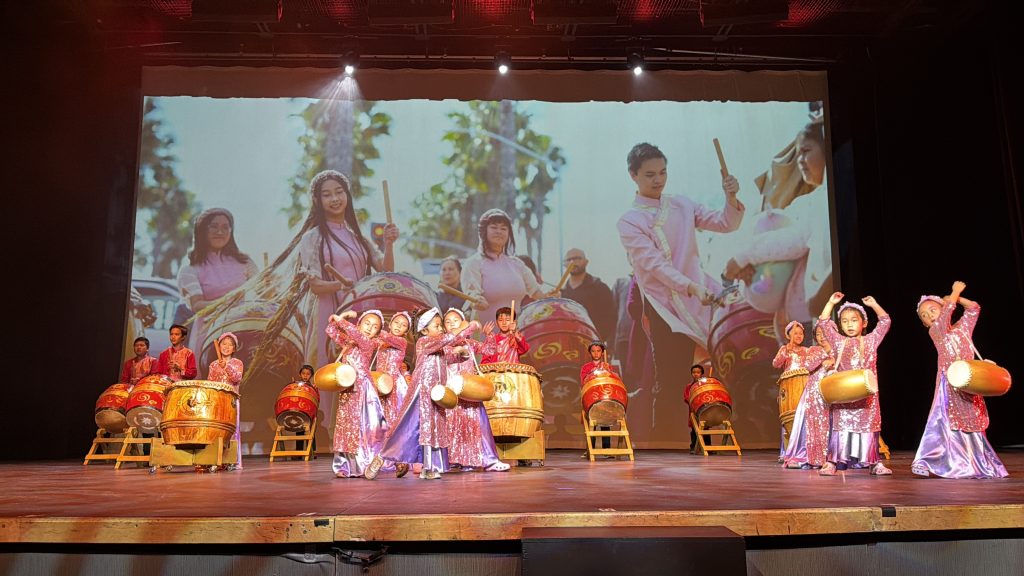
Some of the most beautiful images of the program were the young performers in traditional Vietnamese dresses. Their bright smiles said as much about the future of Vietnamese culture as any speech could.
These young people live completely modern American lives. They attend American schools, speak English, use technology, listen to contemporary music, and move comfortably through American society. Yet they can also stand on a stage wearing traditional Vietnamese clothing, perform music and dances passed down through generations, and know that this heritage belongs to them too. That is cultural preservation at its best. It is not asking the next generation to choose between being Vietnamese and being American. It gives them the confidence to embrace both.
A Feast for the Eyes
Vietnamese Culture & Arts Day was als simply beautiful.
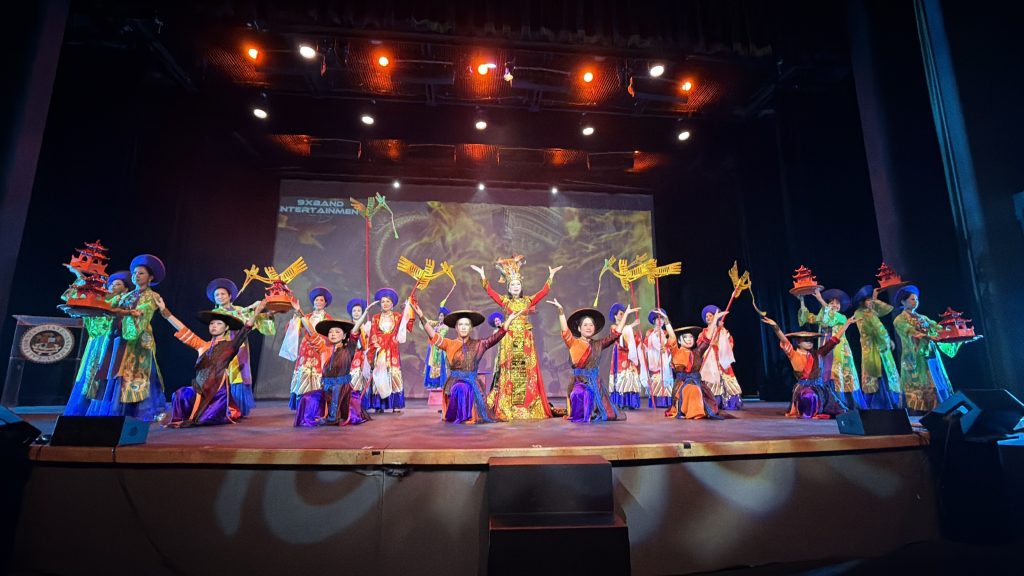
This was one of those events where you had to be there to fully appreciate it. Photographs can capture a costume, but they cannot reproduce the experience of seeing an entire stage suddenly fill with brilliant colors, flowing fabrics, traditional instruments, music, movement, and performers of different generations.
It was truly a feast for the eyes.
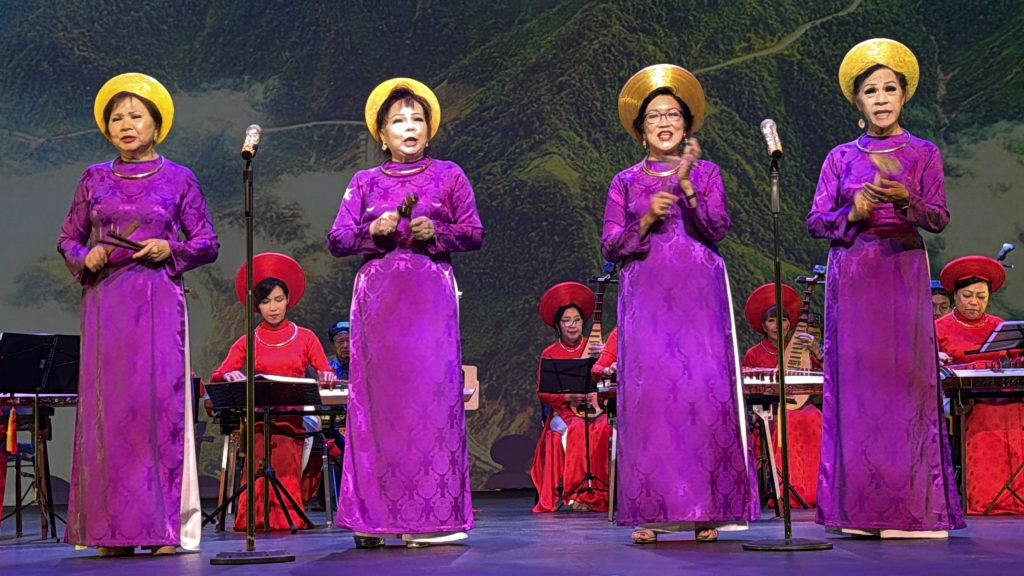
The colorful áo tứ thân, the traditional four-part dress of northern Vietnam, brought another time and region of the country onto an American stage. The costumes themselves became storytellers. Then there were the traditional musical instruments—an extraordinary reminder of the sophistication and diversity of Vietnamese music. Some instruments have only one string, while others have 16 strings, each producing distinctive sounds that generations of Vietnamese people immediately recognize.
For young people in the audience, seeing these instruments actually played can awaken a curiosity that a photograph in a textbook never could.
The Music That Takes Us Home
For me, one of the most personal moments came through the melodies of vọng cổ, the music of southern Viet Nam that I grew up with. Music has an extraordinary relationship with memory. Sometimes only a few notes are needed. Suddenly you remember people. You remember voices. You remember a place. You remember a feeling you may not have thought about for decades.
Hearing vọng cổ in a theater in Westminster reminded me that preserving culture is not an abstract academic exercise. Culture lives within us. A melody can travel thousands of miles and more than half a century and still find its way home.
Northern traditions, southern melodies, regional costumes, folk dances and instruments all belonged on the same stage because together they showed the extraordinary diversity contained within Vietnamese culture itself.
“The Epic History of Viet Nam”
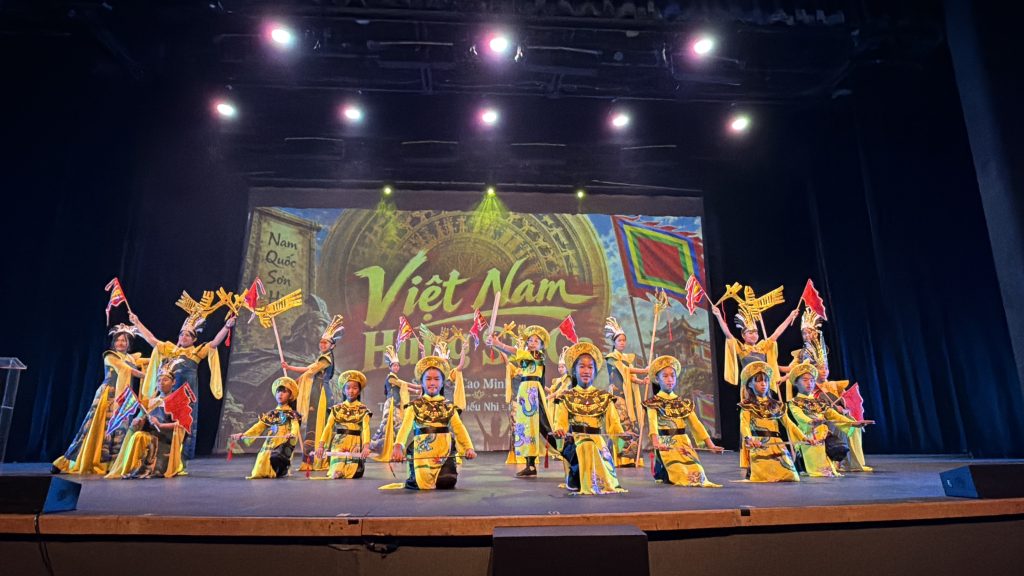
One of the outstanding presentations was the musical skit “The Epic History of Viet Nam,” composed and directed by Dr. Cao Minh Hung.
It was an ambitious idea: to use music and performance to tell the epic story of Vietnamese history. The production demonstrated why performing arts can be such a powerful educational tool. History written on a page provides knowledge. History presented through costumes, music, movement and storytelling can create an emotional connection.
For younger Vietnamese Americans especially, that distinction matters. A historical date may be forgotten after a lesson. An image, a song, a dramatic scene, or a powerful performance can remain in the memory for years. The Epic History of Viet Nam did more than entertain. It helped connect an audience to the much larger historical story from which Vietnamese culture emerged.
Collaboration Is Community
There was another message embedded in Vietnamese Culture & Arts Day that should not be overlooked.
Seven organizations collaborated to create this program.
Each organization has its own history, leadership, performers, volunteers, priorities and traditions. Yet for this event, they came together around something greater than any individual organization: the preservation of Vietnamese heritage. That is community unity in practice.
It is easy to use the word unity. It is more difficult to share a stage, coordinate performers, combine resources, accommodate different organizations and work toward a common goal. This program demonstrated what becomes possible when organizations collaborate instead of compete. And perhaps that lesson is as important to preserve as the music itself.
When Culture Is Alive
Language remains at the heart of this effort. When we preserve Vietnamese language, we preserve much more than words. Language carries humor, poetry, songs, family relationships, expressions, history and ways of understanding life that cannot always be translated perfectly into English.
But language needs an environment in which it can live.
Young people need to hear Vietnamese spoken and sung. They need opportunities to learn it. They need to see traditional clothing worn proudly rather than stored away. They need to hear the đàn bầu and other traditional instruments performed rather than simply read their names. They need to experience vọng cổ, folk songs and regional dances. They need to know the history behind the traditions. Most importantly, they need a place where they can participate.
That is why events such as Vietnamese Culture & Arts Day are important. It is one thing to preserve culture. It is another to create the opportunity to showcase it.
The seven participating organizations have collectively invested decades in preserving Vietnamese culture. Assemblymember Tri Ta and the organizers helped bring those efforts together and give them greater public visibility. The performers gave the traditions life. The families and audience gave them an appreciative community. And the young people gave us something even more valuable: the confidence that the story will continue.
Fifty-one years have already produced two generations born and raised in America. Another generation will arrive sooner than we think. Our responsibility is not merely to tell them where their families came from. It is to leave them the language, music, stories, history, traditions—and the stages—through which they can discover that heritage for themselves.
On October 4 at the Rose Center Theater, Vietnamese culture was not something being remembered from the past.
It was being performed in the present and entrusted to the future.

