
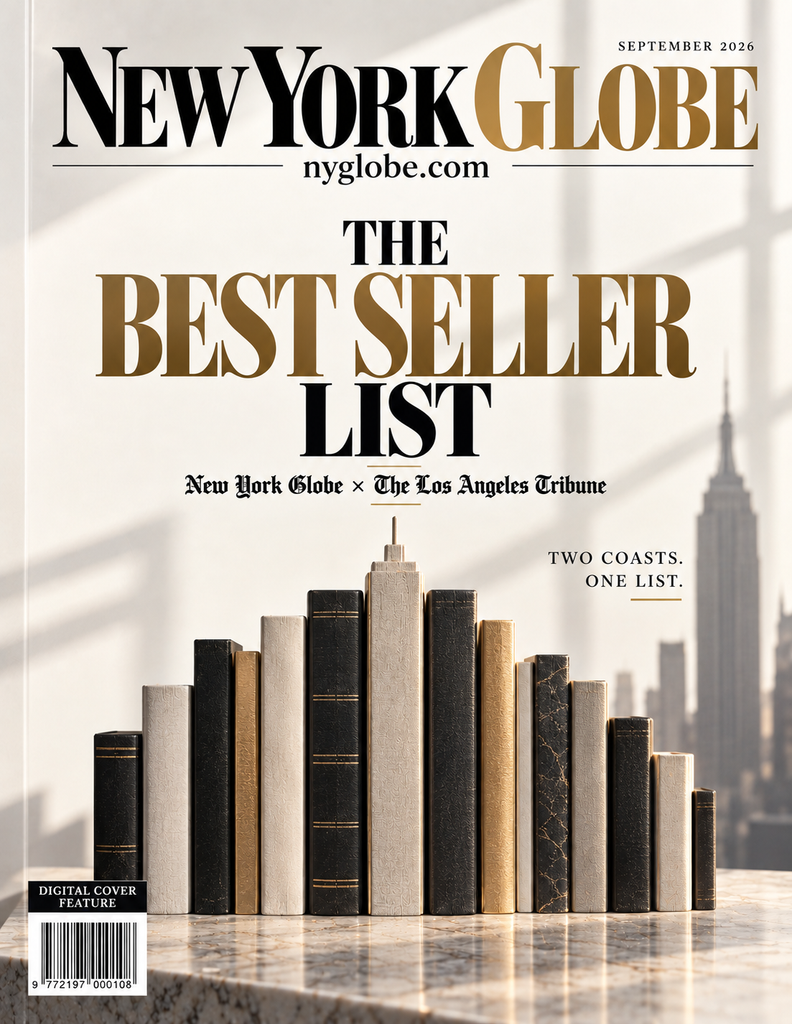
The New York Globe and The Los Angeles Tribune are collaborating on a national book list that looks beyond sales alone, weighing critical reception and cultural significance alongside commercial performance.
NEW YORK — For decades, the phrase “bestselling author” has carried an unusual amount of power.
Printed across book jackets and author biographies, the designation can influence readers, retailers, speaking opportunities and, in some cases, the trajectory of an author’s career. Yet beneath the prestige is a question the publishing industry has never entirely resolved: What, precisely, makes a book worthy of being called a bestseller?
The New York Globe is taking a broader view.
Beginning with its collaboration with The Los Angeles Tribune Bestseller List, the New York Globe Bestseller List will evaluate books using a methodology that considers not only sales performance, but also critical acclaim and cultural significance.
The idea is not to make sales irrelevant. It is to recognize their limitations.
A book can sell extraordinarily well because it has captured the public imagination. That matters. But sales figures can also reflect distribution, advertising budgets, an author’s existing audience, retailer participation and the ability of a publisher to generate large numbers of purchases within a particular period.
Meanwhile, a consequential work can develop differently.
It may build an audience gradually. It may emerge from an independent publisher. It may introduce an unknown writer. It may become influential within a particular profession or community before reaching a mass audience. And some books ultimately remembered as important were never defined by spectacular opening-week sales.
That distinction sits at the center of the New York Globe’s new approach.
Sales Still Matter. They Just Aren’t Everything.
The bestseller list has traditionally functioned primarily as a measure of commercial activity. That makes intuitive sense: if large numbers of people are buying a book, the marketplace is communicating something worth recording.
But measuring the marketplace and measuring significance are not necessarily the same exercise.
The New York Globe methodology seeks to bring those ideas closer together.
Sales will remain an important signal of reader demand. Critical reception will provide another measure, recognizing books that distinguish themselves through their ideas, writing, research, originality or execution.
The third consideration is intentionally less mechanical: cultural significance.
Editors may consider whether a book is contributing meaningfully to public conversation, advancing an important idea, influencing its field, documenting something of lasting value or demonstrating an impact that conventional sales measurements alone might fail to capture.
That editorial component is important.
Algorithms are exceptionally good at counting. They are less capable of answering a more complicated human question:
Does this book matter?
A Problem Larger Than Any One List
The publishing business has changed considerably.
Authors can now reach readers through independent publishing, specialized presses, direct sales, online communities, podcasts, social platforms and distribution systems that did not exist when many of publishing’s traditional institutions were established.
The result is a considerably more fragmented marketplace.
A writer can have genuine influence without necessarily producing the concentrated retail activity associated with conventional bestseller status. Conversely, a sophisticated marketing operation can generate substantial short-term sales without necessarily producing a work of comparable long-term importance.
Neither observation diminishes commercial achievement.
It simply suggests that commercial achievement is one kind of achievement.
The New York Globe Bestseller List is being built around that distinction.
New York Meets Los Angeles
There is also symbolism in the partnership itself.
New York remains synonymous with American publishing and journalism. Los Angeles occupies an equally distinctive place in entertainment, media and global popular culture.
The collaboration between the New York Globe and The Los Angeles Tribune brings those perspectives together.
Two coasts. One list.
Rather than creating competing East Coast and West Coast measures of literary success, the publications intend to collaborate around a shared philosophy: recognize books that demonstrate meaningful achievement, whether that achievement is reflected in the marketplace, critical reception, cultural influence—or a compelling combination of all three.
The respective publications will retain their identities, but their collaboration creates the possibility of something broader: a national platform for discovering books that might otherwise fall between the cracks of conventional measurement.
The Human Judgment Behind the Numbers
There is an obvious challenge to such a system.
Sales can be counted. Cultural significance requires judgment.
That makes transparency and editorial discipline particularly important.
The objective should not be to replace an imperfect numerical system with an arbitrary one. It should be to combine measurable evidence with informed editorial evaluation, acknowledging openly that determining which books matter has always involved more than mathematics.
Book critics do it.
Editors do it.
Libraries do it.
Universities do it.
Readers ultimately do it.
The New York Globe Bestseller List simply brings that judgment into the definition of bestseller recognition itself.
A commercially successful book may qualify because its extraordinary readership represents undeniable cultural momentum. A critically celebrated work may distinguish itself through exceptional quality. Another title may earn consideration because its ideas are beginning to influence a larger conversation.
The most significant books may satisfy all three.
Expanding the Meaning of Success
For authors, particularly those outside the largest publishing machinery, the implications could be meaningful.
Talent has never been distributed according to marketing budget.
An extraordinary author without enormous institutional backing can write an extraordinary book. What that author may lack is the infrastructure necessary to produce tens of thousands of trackable transactions within a narrow window.
That should not automatically make the work invisible.
The New York Globe and Los Angeles Tribune initiative is based on a simple proposition: prestige should recognize achievement rather than merely amplify advantage.
Sales deserve recognition.
Critical excellence deserves recognition.
Cultural influence deserves recognition.
And occasionally, a book arrives that manages to achieve all three.
Those are the books a meaningful modern bestseller list should be capable of finding.
For the New York Globe, that represents more than a new ranking system. It is an attempt to reconsider what publishing success looks like at a moment when authors have more ways than ever to reach the world.
The bestseller list has historically told readers what people are buying.
Perhaps the next generation of bestseller lists can also help answer another question:
What is worth reading?

