
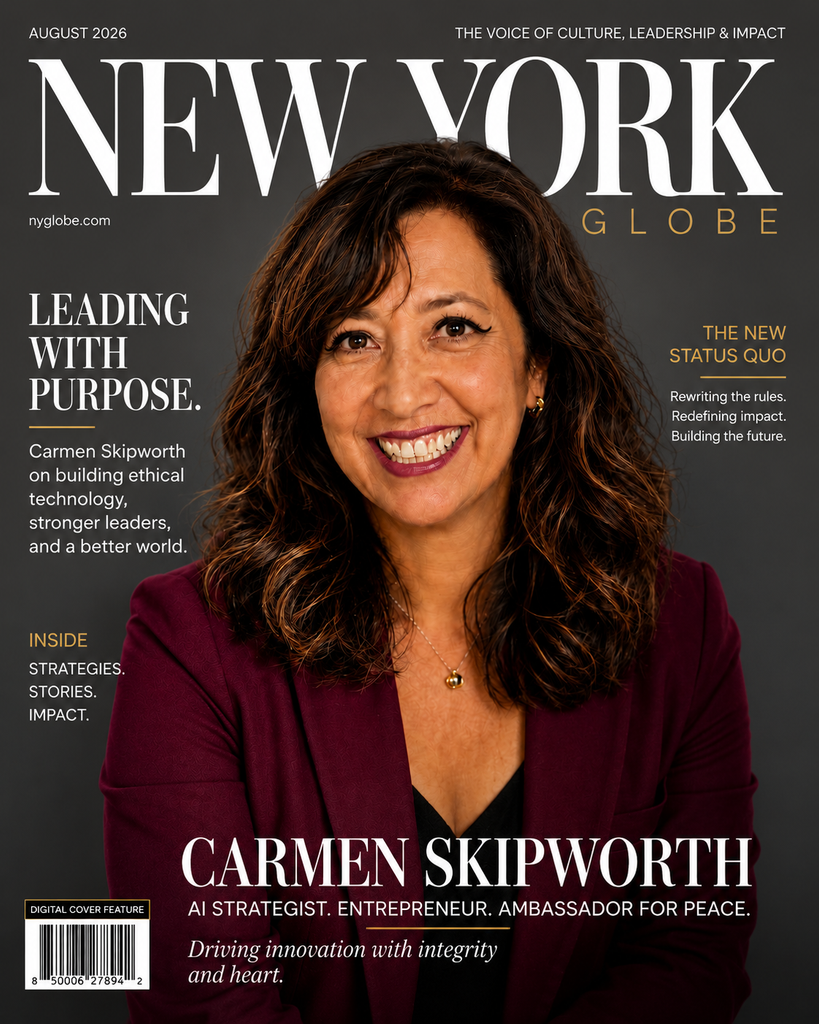
The AI strategist and author of Lead with Intelligence argues that tomorrow’s strongest leaders won’t compete with artificial intelligence—they’ll learn how to combine it with the qualities that remain distinctly human.
NEW YORK — As artificial intelligence rapidly changes how companies operate, Carmen Skipworth is focused on a question that extends beyond which technology businesses should adopt next.
What kind of leaders will this new era require?
For Skipworth, an AI strategist, author and international speaker, the answer lies in combining technological capability with qualities machines cannot easily replicate: judgment, empathy, adaptability, creativity and ethical leadership.
It is the central argument behind her book, Lead with Intelligence: A Woman’s Guide to Thriving in the Age of AI, which was published in 2025 and subsequently featured in the Forbes Business Council Executive Library. (Forbes Councils)
Rather than positioning artificial intelligence as a substitute for human leadership, Skipworth presents it as something leaders can learn to use strategically while strengthening the human qualities that differentiate them.
Leading With Intelligence
At the heart of Skipworth’s book is what she calls the L.E.A.D. framework: Lead by Example, Empower Others, Amplify, and Make a Difference.
The book addresses AI adoption alongside issues including confidence, ethical decision-making, influence and organizational leadership. Its intended audience includes executives, entrepreneurs and emerging leaders attempting to navigate workplaces increasingly shaped by artificial intelligence. (Forbes Councils)
Skipworth has been particularly deliberate about addressing women.
Her premise is that characteristics traditionally associated with effective human leadership—including empathy, collaboration and adaptability—may become more valuable, not less valuable, as artificial intelligence becomes more capable. The challenge is for leaders to become technologically fluent without abandoning those strengths. (Forbes Councils)
That philosophy has become the foundation of her broader work through Lead with Carmen, where she works with executives, entrepreneurs and organizations on AI strategy, leadership and digital transformation. (Lead with Carmen)
A Career Built Across Borders
Skipworth’s path to artificial intelligence did not begin with the current AI boom.
A George Mason University alumni profile traces her professional journey from studying International Relations and Affairs to work that took her from Hong Kong to the U.S. Embassy in London and eventually San Diego. The university notes that she gravitated toward technology early in her career and became conscious of how few women she encountered in the field. (GMU Alumni)
That combination of international experience, technology and leadership provides useful context for her work today.
Before the explosion of generative AI made artificial intelligence an everyday boardroom conversation, Skipworth was already working in IT consulting, digital strategy and AI integration. Her Forbes Business Council profile describes her work helping businesses identify opportunities for AI and machine-learning technologies, improve operational efficiency and develop growth strategies. (Forbes Councils)
In a July 2025 article for Forbes Business Council, Skipworth argued that AI had already moved beyond the realm of futuristic speculation and into everyday life and business. Her message was not that organizations should embrace technology indiscriminately, but that adapting thoughtfully and responsibly had become essential. (Forbes)
From Technology to Leadership
That distinction has become increasingly important.
There is no shortage of conversation surrounding new AI models, automation systems and productivity tools. Skipworth’s work increasingly focuses on what happens after organizations acquire the technology.
Her argument is that possessing AI tools and knowing how to lead with AI are fundamentally different capabilities.
She has publicly framed successful AI leadership as a combination of strategic thinking, ethical judgment, digital fluency and a willingness to innovate. In that framework, technology becomes an amplifier of leadership rather than its replacement. (LinkedIn)
It is also why Lead with Intelligence is ultimately less about software than its title might initially suggest.
The technology will continue changing.
The larger challenge is developing leaders capable of making intelligent decisions about how that technology should be used.
A Growing Platform
Skipworth’s message has continued to move beyond the page.
In June 2026, Entreprenista profiled her work helping women navigate leadership in the AI era and reported that she had recently spoken at the United Nations. The publication also highlighted her work as a speaker, author, book coach and podcast host. (Entreprenista)
Her current platform describes her as an international keynote speaker and AI strategist working with executives, entrepreneurs and women leaders. (Lead with Carmen)
And the conversation surrounding Lead with Intelligence is continuing well beyond its initial publication. An author event scheduled for August 28, 2026, will feature Skipworth discussing the book and offering a practical roadmap for people seeking to understand AI while strengthening their leadership and remaining relevant in a changing workplace. (The Folded Leaf Foundation)
Keeping Humanity at the Center
The speed of artificial intelligence creates an understandable temptation to make predictions about what machines will eventually be able to do.
Skipworth’s work points toward a different question:
What should humans become better at doing?
If AI can accelerate analysis, automate repetitive work and dramatically increase access to information, then leadership increasingly depends upon knowing what questions to ask, what decisions to make, where ethical boundaries belong and how technology should ultimately serve people.
That is where Skipworth’s message carries weight.
The future she describes is neither anti-technology nor blindly enthusiastic about it. It is a future in which leaders learn to use increasingly powerful technology while remaining accountable for the human consequences of their decisions.
In an era obsessed with artificial intelligence, Carmen Skipworth is making the case for something equally consequential:
more intelligent human leadership.

