

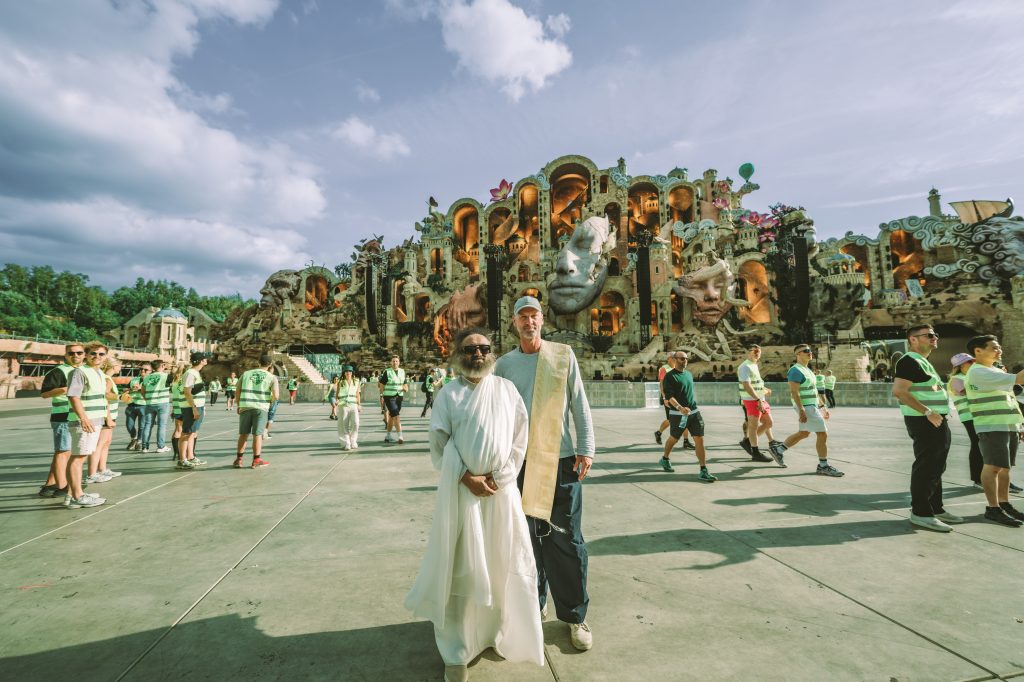
On a July afternoon in Boom, Belgium, the organizers of Tomorrowland, the electronic music festival that draws revelers from every corner of the world, turned their stage over to an unlikely guest: a meditation master in flowing white robes.
Gurudev Sri Sri Ravi Shankar, founder of the Art of Living Foundation, spoke at the festival’s Love Tomorrow Summit on July 23, an ideas forum built this year around the future of intelligence. The program explored the artificial kind that dominates every boardroom, the natural kind that evolution wrote into living systems, and the collective kind that emerges when groups think together. Gurudev came to talk about a fourth kind, and he gave it a name of his own. “In this age of artificial intelligence, of course, there is no going back from artificial intelligence,” he told the crowd. “What on earth is absolute intelligence?”
His answer unfolded less like a lecture than a live experiment on the audience’s attention. Again and again, a dozen times or more, he interrupted himself to ask the same question: “Are you here?” When the back rows went quiet, he called on them directly. The bit drew laughter, but it carried a diagnosis. “Our mind keeps vacillating from past to future, future to past,” he said. “Our retention span has reduced to 30 seconds.” At a festival engineered for sensory overload, the world’s most famous breathing teacher was taking the crowd’s pulse, and the crowd knew it.
The framework he offered was disarmingly practical. Consciousness, he explained, has four functions: the mind, which perceives through the senses; the intellect, the voice that judges, accepts, and rejects; the memory, where we get stuck (“trauma is nothing but a memory which is so stuck”); and something deeper that does not change, the witness through which we notice everything else changing. That last layer, he said, is what “gives you the wow moment in life.” It is ancient yet always fresh, like a river that has run for ages while its water is new every day.
He was equally direct about why tens of thousands of young people travel to a field in Belgium every summer. “Our head always wants something new; our heart always longs for something old,” he said, noting that we take pride in the latest gadget and in an old friend, never the reverse. Music, he told them, already carries the crowd beyond the thinking mind and lifts its energy. “But there is something beyond that. That is meditation, where you tap into the source of energy and then become the source of energy.” His definition was the simplest line of the afternoon: “Meditation is a journey from sound to silence.”
Then came the sentence that landed hardest in a festival crowd. People chase altered states, he acknowledged, through substances, through sound, through spectacle, because “we want to go to another dimension in life. But that is available right in your own breath. Without any expenses, you can feel the high.”
Coming from most speakers, that would be a slogan. Behind Gurudev stands an unusual body of evidence. SKY Breath Meditation, the rhythmic breathing practice at the center of the Art of Living’s programs, has been studied by researchers at Yale, Harvard, Stanford, and Cambridge, with published research documenting reductions in stress and anxiety of 20 to 50 percent within days and reductions in post-traumatic stress symptoms of up to 53 percent. Over 45 years his movement has spread to 182 countries and reached more than a billion people, teaching in war zones, prisons, veterans’ halls, and universities. He has meditated with more than a million people on the National Mall in Washington and holds a Guinness World Record for 12 million people meditating with him simultaneously online.
The moment is about to get a measurement. Gallup, in partnership with the Art of Living, is conducting the first ever global study of meditation on its World Poll, spanning more than 140 countries, with the first results expected later this year. For the first time, the world will have a population-level picture of who practices and how it tracks with stress, loneliness, and life satisfaction. The practice Gurudev demonstrated in Boom is about to have its data moment.
He closed the talk the way he closes most of them, with a deep experience of the self, leading the festival into a short meditation before the music resumed. His parting logic tied the whole afternoon to the summit’s name. “Loving tomorrow is loving yourself,” he said, “because you are the one who was there yesterday, who is here today, and you will continue to be there tomorrow.” Then, one last time, the question that was really the point: are you here?

